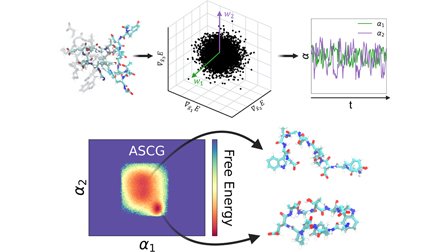
We introduce Active Subspace Coarse-Graining (ASCG), an interpretable framework for systematic bottom-up coarse-graining trained from atomistic molecular dynamics simulations that simultaneously defines the coarse-grained mapping, effective interactions, and the equations of motion within one unified mathematical framework. We employ active subspace learning to identify linear projections of atomistic degrees of freedom that maximally describe gradients of the potential energy, yielding a reduced set of coarse-grained variables that capture the dominant collective motions across the potential of mean force. Effective coarse-grained forces and noise terms are obtained directly from the same projection, eliminating the need for separate parameterization schemes. We demonstrate ASCG on three biomolecular systems(dialanine, Trp-cage, and chignolin), showing that the method captures many-body intramolecular conformational effects while eliminating all solvent degrees of freedom and reducing solute dimensionality by more than 90%. The resulting free energy surfaces are recapitulated withJensen–Shannon divergences as low as 0.034. ASCG trajectories are integrated with time steps up to 100 fs, around four to ten times larger than those possible with conventional coarse-graining methods, while ASCG models remain accurate with as little as 100 ns of training data.In its current formulation, ASCG operates on global intramolecular representations and is, therefore, best suited to single-molecule systems, while future extensions to intermolecular interactions will require locality-aware representations. Nonetheless, these results establish ASCG asa robust, data-efficient approach for learning coarse-grained representations of complex intramolecular forces while representing a departure from traditional particle-based models.